

Does being disabled make us less creative?
Or, rather, does it limit our access to creative endeavours?

Did you know that as we grow up, we lose our creative genius?
In the 60s, NASA worked with Dr. George Land to study divergent (outside of the norm) and creative thinking in kids. They studied 1,600 children aged four and five, and found that 98% of them were creative geniuses.
So they decided to follow these people as they aged.
By age 10, only 30% were creative geniuses.
By 15, just 12%.
And by the time they were adults (~30 years old), that number dropped to 2%.
The thought here is that creativity gets trained out of us.
We enter systems that keep us contained in traditional and expected ways of thinking, framed by right and wrong answers.
We erase that imaginative thinking with judgments such as “it’s never going to work,” “that’s not going to achieve anything,” “that’s too expensive.”
We learn to praise and admire the logical, and let the creative fall to the wayside.
When I first read about this study, I was fascinated. It prompted me to look inward at my own creativity and to ask my five-year-old self where her creativity had gone.
I journaled a little about it. I talked to my cousin about it. And I realized that while the traditional workings of education and work environments had had their own role in tamping down my creative genius, becoming disabled had also been a significant contributor.
Once I became disabled, I stopped dreaming big about what my life could look like. The path toward my future was framed entirely by my need to prove I could do “normal” things — not outstanding things, not expansive things.
So, I went to university, and I chose the Masters program at the well-known university, and I took a job in consulting (which is probably the least five-year-old Ali decision I’ve ever made — she was busy dreaming of being a singer).
I chose the things that told the world that I was ok. That I didn’t need their help. That I could still earn a living and contribute and be productive, despite my disability.
Yeesh.
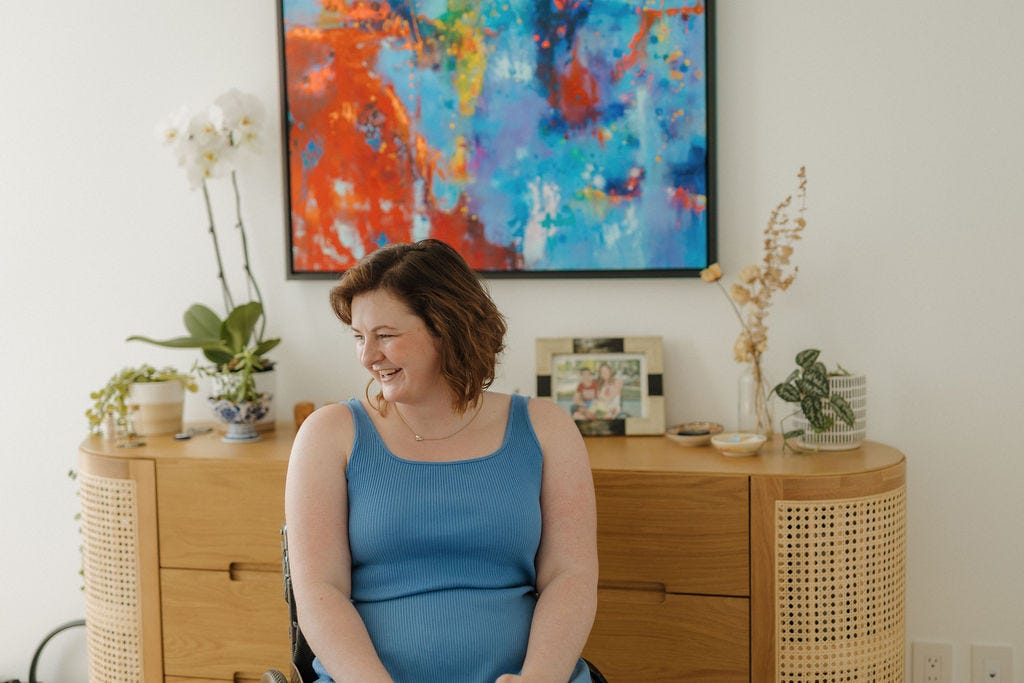
If you had told me then that I would be building what I’m building now, I would have been terrified for myself.
I would have been shocked at the sheer gall of choosing to follow what I want to do, what I feel called to do, instead of what “makes sense.”
I do mourn the years I spent not being more creative with my own vision for my life. But I’m also not surprised that they’re a part of my history.
In fact, I’d wager that they’re a part of many disabled experiences — because we all exist in systems that will either revere us for “overcoming our limitations” while simultaneously berating us for not doing enough and taking up too many resources. And that creates this need to prove ourselves worthy, at whatever cost.
But we are worthy just for the simple fact that we exist.
And our creativity and expansive thinking is worthy. It’s also beautiful. Imagine a world where more disabled folks could bring their unique ideas to the conversation.
Imagine the many perspectives we’re missing out on because that world doesn’t quite exist yet.
What I will say is that my disability did make me creative in other ways. It forced me to be incredibly resourceful. I often have to think about and solve problems with a lens that might not have been applied before.
Also, when you’ve fallen out of your wheelchair in someone else’s bathroom, you better believe you need creative thinking to think about what items can become steps that you shimmy your way back up to your chair with.
I feel so grateful that the last few years have given me the space to tap back into some of my creative genius.
To ask what if?
To think more expansively.
To choose what feels uniquely mine, and create a way to share it with the world.
It’s something that takes practice, and even now, I still find myself unlearning the urge to choose the logical, the structured, the safe. But I’m so excited to meet the version of me that exists on the other side of that.
Before I sign off, I would be remiss not to acknowledge how privileged I am in having that space to explore. Some disabled folks literally don’t have the capacity to play and be creative. Their time and energy is spent on survival, because the systems meant to protect them are failing them.
They have to fight for every ounce of care they receive, and it’s still not enough. And it means that they don’t have room to spend time in their imagination.
And that breaks my heart.
Because creativity is part of being human. It’s how we imagine better systems for ourselves and others. It’s how we dream beyond the constraints placed on us. It’s how we build community.
So if you’re reading this and feeling like your creative genius has been tucked away somewhere — trained out of you, shamed out of you, exhausted out of you — I promise you it still exists in you. It might just be buried under responsibility, under fear, under the very real weight of navigating the world in a disabled body.
Maybe it starts small. A journal entry. A voice note on a thought you had. A question you let yourself sit with a little longer than usual. A tiny act of choosing what feels interesting instead of what feels impressive.
What if our creativity isn’t something we have to rediscover, but something we gently remember?
What if reclaiming it, in whatever way is accessible to us, is its own quiet rebellion?
And what might become possible if more of us allowed ourselves to imagine, again?
I must admit, I came here thinking I disagreed with the sentiment, feeling that being disabled forced us to be creative just to get through our days (as you so thoughtfully acknowledged), but found myself feeling seen in a way I didn’t realize I had been missing. Beautifully said, Ali, thank-you for sharing this.
I am resonating so much. The weight of navigating this capitalist, ableist, hierarchial world in a disabled body is very real and its impact, lingering. The weight and the emotions are often invisible and the labour of education often goes unnoticed. I live in India and living as disabled all my life has shown me since a tender age, how scary, rushed and unkind the people can be to my community, to me, and the languages while talking about disabled people continues to be outdated, hurtful and alienating. There are so many layers and without the support of community, I know I cannot unpack all those layers. Spaces like these online, as well as on Substack, help me uncovering that. I am also exploring that, through my writings. Thank you for this important piece on Disability x Imagination ❤️